Rocket Car Ball
- 4.0
- Rating
- 50.00M
- Installs
- Free
- Price
 Analysis by App-foxy
I spent time with Rocket Car Ball as a quick sports game for a shared Android device, and its appeal became clear almost immediately: it turns a familiar soccer idea into a noisy, arcade-style match where the players are rocket-powered cars. That simple combination makes it easy to explain to someone who has never played it. You do not need to understand a complicated league system or learn a large roster before having fun. You drive, chase the ball, and try to send it toward the opposing goal.
What surprised me is how well the game fits short household play sessions. One person can pick it up for a few minutes, then hand the phone or tablet to someone else without a long tutorial or a story to follow. At the same time, the controls demand more judgment than the store summary suggests. Steering toward the ball is only the beginning; timing a boost, recovering after a missed hit, and avoiding an awkward angle often decide whether a play works.
Rocket Car Ball is a free sports game from Words Mobile, aimed at Everyone. It has reached over 50 million installs and carries a 4.0 average from around 218 thousand ratings, which gives a useful sense of its broad reach without making it sound like a perfect game. I found it best understood as a casual arcade interpretation of car soccer rather than a deep competitive simulation.
You May Also Like

 Google Keep - Notes and lists
Google Keep’s Quiet Growth Shows the Appeal of Simpler Notes
As mobile work gets busier, Google Keep keeps winning a simple contest: capture a thought quickly, find it later, and get on with the day.

 Blood Strike: 2.5 Anniversary
Blood Strike’s Loadouts Turn Every Drop Into a Tactical Gamble
A close look at Blood Strike’s custom loadouts: how fast access to signature weapons reshapes its battle royale rhythm, rewards preparation, and narrows the gap between fights.

 Pandora - Music & Podcasts
Pandora’s Music Is Easy to Start, but Harder to Recover
Pandora’s strength is its low-effort path from a seed to a station. Its weak spot is how much confidence it asks you to place in connection, setup, and quiet recovery.

 8 Ball Pool
 Is Built on Rivalries, Rematches, and Routine
A close look at the rivalries, rematches, shared routines, and unanswered safety questions that turn a quick pool match into a persistent mobile community.

 Samsung Music
’s Quiet Strength Is Playing What You Already Own
Its reach comes less from spectacle than from dependable access to a personal library. That simplicity is both the app’s strongest retention engine and its ceiling.

 AccuWeather: Weather Radar
AccuWeather Review: A Quick, Clear Forecast for Everyday Decisions
For everyday plans, the best forecast is the one you can understand quickly. AccuWeather makes rain timing, radar, and local conditions easy to act on, with a few trade-offs.
More From Our News Desk



How the car-soccer idea works in everyday play
I found that the car-soccer idea works best when I treat each match as a small positioning puzzle, not a race to reach the ball first. A useful habit is to pause for a moment after a messy collision, find the ball’s new direction, and then choose an approach rather than chasing blindly. That keeps the action readable and makes it easier to enjoy the game’s unusual mix of motion and sport.
A shared-device game that is easy to pass around
The strongest household use case is a short turn-taking session. Imagine two people waiting in the same room while one has a few spare minutes: one player can start a match, play until it ends, and pass the device over without needing to explain a complex control scheme. The basic objective is visible on the screen, and the exaggerated car movement makes mistakes entertaining instead of frustrating every time.
I also think it works for mixed experience levels. A player who rarely touches sports games can understand “get the ball to the other goal” quickly, while a more practiced player can focus on positioning and momentum. That does not make the game perfectly even. Someone who has learned how the car turns and accelerates will still have an advantage, but the gap is less intimidating than in a traditional soccer game with many buttons and player-specific actions.
The best way to share it is to agree on a simple rotation before starting. On a common phone or tablet, this avoids the familiar problem where one person keeps playing because the matches are quick and “just one more” becomes several more. Rocket Car Ball does not need a family-management pitch to be useful in a household; it simply benefits from clear expectations about whose turn it is and when the session ends.
Controls reward anticipation more than frantic swiping
My first instinct was to chase the ball directly, but that usually produced weak touches. The car keeps moving with enough momentum that a direct approach can send the ball sideways or leave the vehicle facing the wrong direction. I had better results by approaching from an angle and thinking about where the ball would go after contact, not only about reaching it first.
That is one of the more important tips I can offer: treat the car like a moving object with a turning cost. If you are already near the goal, a rushed hit may be worse than circling briefly and lining up a cleaner shot. This is especially useful for younger or inexperienced players, because it turns random-looking failures into something they can understand and improve.
Boosting also deserves restraint. Using extra speed at the wrong moment can make a dramatic entrance but leave the car out of position after the ball moves away. I preferred saving acceleration for a recovery, a clear run toward an open ball, or a last-second defensive chase. That small change made matches feel less chaotic and gave me more control without making the game feel slow.
Why the 3D presentation helps and where it gets messy
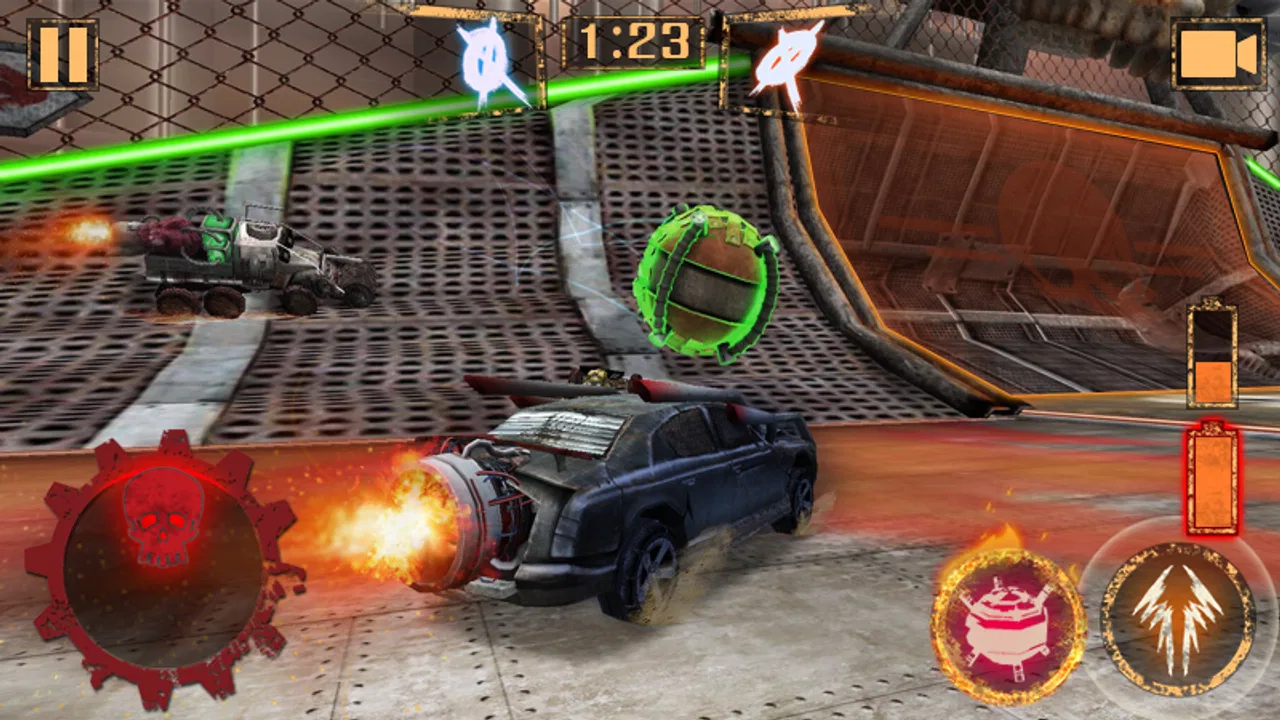
The three-dimensional field gives the action a physical sense that a flat, turn-based sports game would not have. The cars look and feel like they are colliding with a real object, and a successful strike has immediate visual feedback. For a casual game, that clarity matters: a player can often tell whether a mistake came from poor timing, a bad approach, or simply being too far away.
Still, the same movement can create confusion. When several cars converge, the ball may move in an unexpected direction, and a player who is still learning the camera perspective can lose track of the best route. I found that short practice sessions were more useful than trying to master everything in one sitting. A new player should focus first on turning and positioning, then add aggressive attacks once the basic movement feels predictable.
This is not the right choice for someone seeking a carefully balanced football simulation. The car-based physics are the point, but they also make outcomes less controlled than a conventional sports title. If you want realistic passing patterns, detailed player roles, or the feeling of managing a full soccer team, another game in the sports category will suit you better.
Setting boundaries on a shared phone or tablet
Rocket Car Ball is free to download, but it includes in-app purchases ranging from $1.99 to $99.99 per item. That matters more on a shared device than it does on a personal one. Before handing the device to a child or guest, I would make sure the owner of the account knows how purchases are handled and that nobody assumes “free” means every optional transaction is irrelevant.
I would also separate the idea of device access from game progress. A shared phone can make it unclear who is responsible for a change in the game, especially when several people use the same installation. Keeping a simple household rule—one person plays at a time, and nobody changes account or purchase settings—prevents more trouble than trying to sort out a disputed action afterward.
The game runs on Android 5.0 and later, so it is accessible on many older Android devices. That can be useful for a household with a spare phone or an older tablet, but age alone does not guarantee a smooth experience. Screen size, responsiveness, and battery condition can affect how comfortable the driving feels. On a small screen, the action may feel crowded; on a larger display, judging angles was easier for me.
Coordination matters more than winning every match
When two people share a session, talking through the action can make the game more enjoyable. One player can concentrate on moving the ball forward while the other calls attention to an open side or a defensive problem. Even if the game does not turn that conversation into a formal team system, verbal coordination adds a layer that a solo player does not get.
There is a useful lesson here for younger players: the fastest car is not always the most helpful one. Chasing the same ball as another player creates congestion, while spreading out gives the next touch more room. I found that asking, “Where will the ball be after the hit?” encouraged better decisions than simply telling someone to drive faster.
For a household session, I would keep the first few matches cooperative in spirit, even when the game itself frames the action as competition. Let a new player experiment without constant criticism. Rocket Car Ball is at its most inviting when the funny misses are part of the experience. A player who feels pressured to perform perfectly may focus on frantic movement and learn less from each attempt.
Age context and trust on the device
The Everyone content rating makes the game a plausible choice for a broad household audience, particularly when the goal is a light sports activity rather than a mature action game. That rating should still be treated as an age context, not as a substitute for supervision. The important practical questions are who is using the device, who controls the account, and whether the owner is comfortable with the available purchase options.
I would introduce it differently to a child than to an adult. With a child, I would explain the driving objective, agree on a time or turn limit, and make it clear that purchases are not part of ordinary play. With an adult, I would focus more on the physics and the quick-match appeal. The same game can serve both audiences, but the boundaries around device use should not be identical.
Trust is also relevant when several people use one phone. A person who opens the game should not assume that changing settings, spending money, or altering another player’s progress is harmless. Even without inventing special family tools, a clear household agreement is enough to make shared use more comfortable: ask before buying, do not use another person’s turn, and return the device in the state in which you found it.
What the current version means for a new player
The current version is 2.9, and the game was released on April 9, 2018. Those details place it in the category of an established mobile title rather than a brand-new experiment. I approached it with the expectation that its core attraction would be immediate arcade play, not a constantly changing social platform or a deep management experience.
That is an important trade-off. An established, straightforward game can be easier to share because the central idea remains familiar and approachable. On the other hand, players who expect the newest presentation, a large modern progression structure, or highly detailed simulation systems may find the experience limited. I would choose it for accessible car-soccer action, not because I wanted a feature-heavy sports ecosystem.
New players should spend a little time learning the field rather than judging the game from the first chaotic match. The opening impression can be dominated by collisions and missed shots. Once I began using the edges of the field deliberately and stopped turning too sharply near the ball, the matches felt more readable. That learning curve is modest, but it is real.
How it compares with ordinary sports alternatives
Compared with a traditional mobile soccer game, Rocket Car Ball removes much of the team-management burden. You are not choosing a long lineup, arranging a detailed formation, or worrying about the individual identity of every player. That makes it faster to start and better for a spontaneous session, especially when someone else is waiting for a turn.
Compared with a racing game, it asks you to value position over lap time. Driving quickly is useful, but speed without a plan can send you past the ball or away from the goal. A racing fan may enjoy the movement but miss the clean track structure and predictable corners. A soccer fan may appreciate the objective but miss realistic passing and player control.
Compared with a serious competitive sports title, this game is easier to explain and harder to treat as a precise simulation. Its charm comes from the unusual collision between vehicles and football objectives. That makes it a good bridge for someone who likes cars but is not interested in conventional soccer games, while a poor substitute for someone who wants authentic tactics.
The most non-obvious advantage is how quickly it creates a shared vocabulary. After only a few plays, people can talk about lining up a shot, covering the open side, or saving the boost for recovery. The most important weakness is that the same simplicity can wear thin for a player who needs long-term progression or a strong sense of personal development.
Who should install it, and who should skip it
I would recommend it to someone who wants a free, casual sports game with a distinctive hook and short sessions. It is particularly suitable for a shared household device where different people have different gaming experience. The Everyone rating, low entry barrier, and familiar goal make it easy to demonstrate without asking another person to study instructions first.
I would also suggest it to players who enjoy experimenting with movement. The fun is not only in scoring; it is in discovering how approach angle, momentum, and acceleration change the result. If you enjoy learning a small physical system through trial and error, there is more here than the brief premise might imply.
I would skip it if your priority is realistic soccer, a deep career mode, careful online competition, or sophisticated team customization. I would also be cautious about installing it on a device used by several people if nobody is willing to agree on purchase and turn-taking boundaries. The game itself may be easy to start, but shared-device habits still determine whether it remains enjoyable.
My household verdict after playing
Rocket Car Ball works because it takes one recognizable sports objective and gives it an immediately playful physical twist. I enjoyed it most when I treated each match as a compact challenge: approach the ball intelligently, avoid wasting acceleration, and recover quickly after a mistake. Those choices create enough texture to keep the simple idea from feeling completely random.
Words Mobile has made a game that is approachable for casual players, including people who may not normally choose a soccer title. Its free price lowers the barrier to trying it, while the in-app purchase range means the account owner should establish clear boundaries before the game is shared. The age rating supports broad household use, but responsible device habits still matter.
My final recommendation is positive with a clear condition: choose it for quick car-based sports fun, not for a full soccer simulation. On a shared phone or tablet, I would use short turns, explain the controls through play, and encourage players to think about positioning rather than simply racing toward the ball. If that sounds like the kind of light competition your household enjoys, this game is worth a try. If you want detailed tactics, realism, or a long-form sports career, I would look elsewhere.
My practical takeaway: Rocket Car Ball is at its best when the household treats it as a quick, cooperative-to-learn arcade game rather than a serious sporting contest.
FAQs for Rocket Car Ball
01What is Rocket Car Ball and how do I play it?
Rocket Car Ball is an exciting blend of car racing and soccer, where players control rocket-powered cars to hit a ball into the opponent's goal. The game involves using boosts, jumps, and strategic maneuvers to outscore the rival team. Players can choose from various cars and arenas, each offering unique challenges and opportunities for thrilling gameplay.
02Is Rocket Car Ball available on both Android and iOS?
Yes, Rocket Car Ball is available for download on both Android and iOS platforms. Users can find it on the Google Play Store for Android devices and the Apple App Store for iOS devices. Ensure your device meets the necessary system requirements for a smooth gaming experience.
03Are there in-app purchases in Rocket Car Ball?
Rocket Car Ball offers in-app purchases that allow players to unlock additional features, cars, and customization options. While the game can be enjoyed without spending money, purchasing items can enhance the experience by providing access to exclusive content and faster progression through the game.
04Can I play Rocket Car Ball offline?
Rocket Car Ball offers both online and offline modes. Players can enjoy solo matches against AI opponents or engage in thrilling multiplayer battles with friends or other players worldwide. The offline mode is perfect for those who want to practice or enjoy the game without an internet connection.
05What are the age recommendations for Rocket Car Ball?
Rocket Car Ball is designed to be family-friendly and is suitable for players of all ages. However, it is recommended for players aged 10 and older due to the competitive nature of the game and the strategic thinking required. Parents can rest assured that the game is entertaining and safe for children.
Pros
- Engaging gameplay with car-soccer mechanics.
- Vibrant graphics enhance the gaming experience.
- Smooth controls for easy maneuverability.
- Variety of cars and customization options.
- Frequent updates add new features and content.
Cons
- In-app purchases can be pricey.
- Occasional connectivity issues during matches.
- Advertisements can interrupt gameplay.
- Limited offline play options available.
- Some users report lag on older devices.

Rocket Car Ball
Gallery